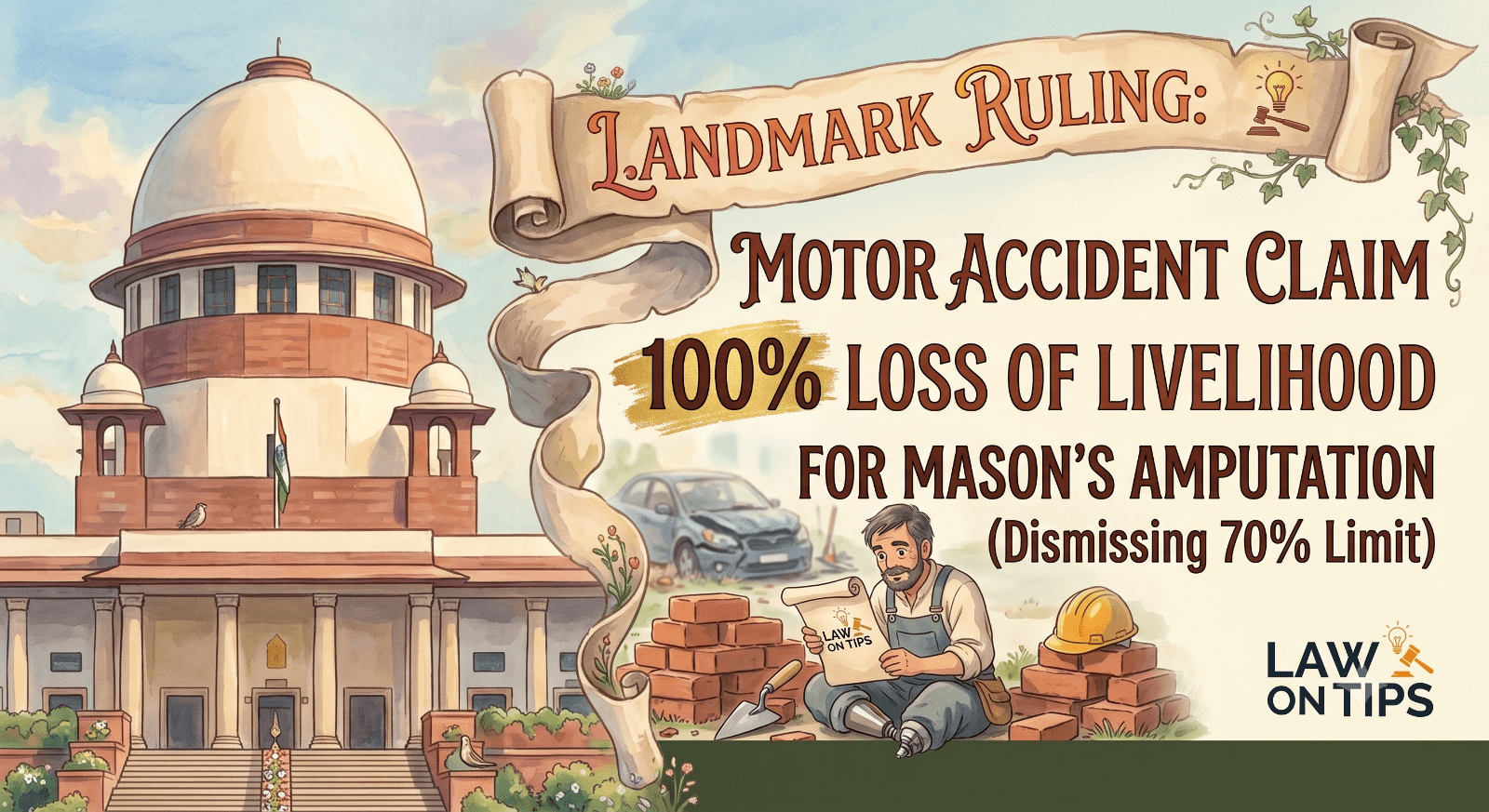
The Supreme Court has held that the percentage written on a person's disability certificate does not, by itself, decide how much accident compensation they receive. What matters is how the injury affects their actual ability to earn a living. For a mason whose right leg was amputated above the knee, that meant a complete 100% loss of earning capacity, not the 70% recorded on his certificate, and his compensation rose to over Rs.40 lakh.
A bench of Justice Prashant Kumar Mishra and Justice N.V. Anjaria, hearing a claimant's plea for enhancement, applied a distinction the Court has long drawn between a person's physical disability and their functional disability the real effect of the injury on their work.
"The Tribunal should not mechanically apply the percentage of permanent disability as the percentage of economic loss or loss of earning capacity."
For anyone whose livelihood depends on physical work masons, drivers, labourers, mechanics, anyone who earns with their body this is a meaningful protection. Compensation after a disabling injury is measured by what the person can no longer earn, not capped by a doctor's impairment figure. The same injury, the Court reaffirmed, can mean very different earning losses for different people, depending on what they do for a living.
A cyclist, a lorry, and a leg lost
On the evening of 18 April 2017, M. Paramesh aged around 30 years old, a mason by trade was riding his bicycle on the left side of the Namakkal Salem highway when a lorry coming from behind struck him. He suffered grievous injuries to his head, jaw, eye and right leg, and the leg was later amputated above the knee. With that, he could no longer do the manual work that was his only source of income. He sought Rs.25 lakh in compensation, saying he had been earning around Rs.20,000 a month.
The Motor Accident Claims Tribunal awarded him Rs.10,84,330 in 2019, fixing his income at just Rs.6,000 a month and treating his loss of earning capacity as 70% the figure on his disability certificate. The High Court, in 2023, doubled his assumed income to Rs.12,000, added future prospects, and raised the award to Rs.23,86,320 but it too treated his earning loss as 70%. Still short of what his injury had cost him, he came to the Supreme Court.
The reasoning
The certificate measures the injury, not the paycheck. This was the heart of the ruling. Relying on its decision in Raj Kumar v. Ajay Kumar (2011), the Court explained that a tribunal must not mechanically equate the percentage of physical disability with the percentage of lost earning capacity. The right question is how the disability affects this person's ability to do their work — and depending on the occupation, the functional loss can be higher than the certified physical disability, right up to 100%.
A mason needs both legs. Applying that test, the Court found the answer obvious. Masonry is physical, manual work that requires the continuous use and support of both legs. With his right leg gone above the knee, Paramesh had effectively lost his capacity to carry on the only trade he had. Tellingly, the other side had never even suggested he could take up some sedentary occupation instead, or that his earning capacity had somehow survived the amputation. His functional disability, the Court held, had to be assessed at 100%, not 70% and his loss of earning capacity recomputed on that basis.
The Court also raised the award for future medical needs. An above-knee amputation means a lifetime of replacing and maintaining an artificial limb, along with continued rehabilitation, so it enhanced that head from Rs.1 lakh to Rs.2 lakh.
Before getting to all this, the Court caught two errors in the High Court's own sums. The High Court had applied its 40% future-prospects uplift to the Tribunal's old, lower income figure rather than to its own revised, higher figure and it had quietly dropped three heads it had actually left untouched, nutrition, clothing and medical expenses, out of its final tally. Once corrected, even the High Court's award should have been higher than the figure it announced.
The takeaway
With earning capacity reassessed at 100%, the prosthesis head enhanced, and the High Court's miscalculations fixed, Paramesh's compensation was raised to Rs.40,29,730, with the insurer directed to deposit the balance within six weeks. The principle that carries well beyond this case is a simple and humane one: a disability certificate records what an injury did to a body, not what it did to a person's ability to earn. For someone whose work depends on the very limb they lost, the law now plainly recognises, the loss can be everything.
Cause Title: M. Paramesh v. VRL Logistics Ltd. and Another
Citation: 2026 INSC 655 | Civil Appeal No. 8708 of 2026 (arising out of SLP (Civil) No. 35337 of 2025)
Bench: Justice Prashant Kumar Mishra and Justice N.V. Anjaria
Date of Judgment: 23 June 2026
Appearances: Counsel for the appellant-claimant and the respondents. (The judgment text does not name the advocates.)